DisclosureImportant reader notice
Important reader notice
This article is for general informational and educational purposes only. It is not legal, financial, tax, medical, security, compliance, or other professional advice, and you should not rely on it as a substitute for advice from a qualified professional who understands your specific situation.
AI tools, pricing, features, policies, laws, and platform terms can change quickly. We work to keep content accurate, but we do not guarantee that every detail is current, complete, or suitable for your use case. Always verify important claims with the original source before making business, legal, financial, safety, or purchasing decisions.
Some links may be affiliate, partner, or sponsored links. If you buy through them, AIUnpacking may earn compensation at no extra cost to you. Sponsored relationships are disclosed where applicable, and compensation does not override our editorial judgment.
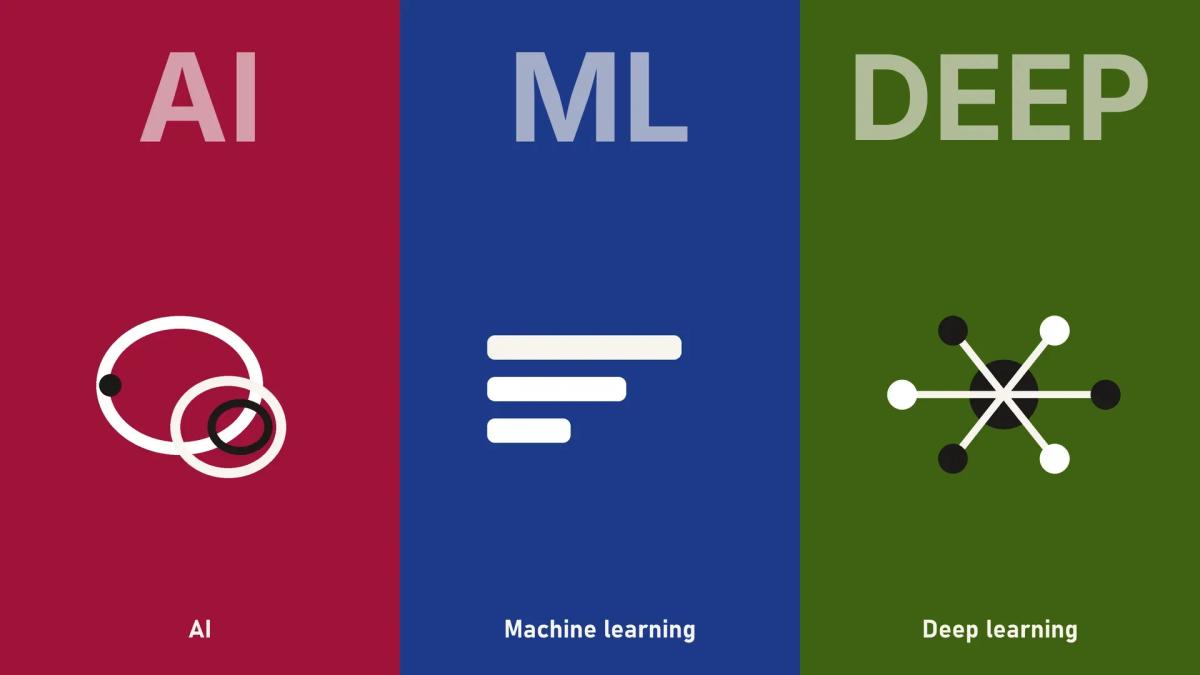
“AI-powered” is stamped on everything these days. Your email client. Your photo app. Your toaster, probably. But when a company says their product uses artificial intelligence, what do they actually mean? A rule-based script that triggers after three failed login attempts? A neural network trained on millions of images? The answer spans a surprisingly wide spectrum, and that spectrum is why the terms AI, machine learning, and deep learning keep getting tangled up.
They are not synonyms. They are nested categories, and understanding what sits inside what matters more than most people realize. It affects what you buy, what you build, what you trust, and what you regulate.
The Nesting Dolls
The simplest way to think about it:
Artificial Intelligence
  -> Machine Learning
      -> Deep Learning
          -> Foundation Models & LLMs
All deep learning is machine learning. All machine learning is AI. But AI is a much bigger tent — it also includes rule-based expert systems, search algorithms, planning engines, and even old-school chess bots that never learn a thing. You can also add a fourth ring: foundation models, massive pretrained neural networks (like GPT, Claude, Gemini, and Grok) that power most of what people casually call “AI” today.
What Is Artificial Intelligence?
Artificial intelligence is the broadest term in the stack. IBM defines it as “the ability of a digital computer or computer-controlled robot to perform tasks commonly associated with intelligent beings” [1]. John McCarthy, who coined the term in 1955 at a Dartmouth workshop proposal, described it as “the science and engineering of making intelligent machines” [2].
In practice, AI is any system that does something normally requiring human intelligence: reasoning, perception, language understanding, planning, problem solving, or decision-making. The approach underneath can vary wildly.
AI comes in three capability tiers recognized across the industry [1]:
- Artificial Narrow Intelligence (ANI): Every AI system that exists today. It does one thing well — play Go, recognize faces, translate text — but cannot generalize. Siri, AlphaGo, and spam filters are all narrow AI.
- Artificial General Intelligence (AGI): A hypothetical system with human-level cognitive abilities across any intellectual task. Not here yet; timeline estimates range from “a few years” to “decades.”
- Artificial Superintelligence (ASI): A system surpassing human intelligence in virtually every domain. Entirely theoretical.
Today’s AI includes rule-based systems (tax engines, medical expert systems from the 1980s), search and planning systems (chess engines, logistics optimizers), statistical approaches (recommendation engines), and neural network-based models (language models, vision systems). The approach underneath changes, but the label “AI” covers all of them.
A Brief History
The term “artificial intelligence” was born at the 1956 Dartmouth Summer Research Project, but the pursuit goes back much further. Alan Turing’s 1950 paper “Computing Machinery and Intelligence” asked “Can machines think?” and proposed the Turing Test [3]. In 1959, Arthur Samuel coined “machine learning” while building a checkers-playing program at IBM [4].
The field has swung through cycles of hype (“AI summers”) and disillusionment (“AI winters”). Expert systems boomed in the 1980s, then collapsed when they proved brittle. Deep learning exploded after 2012, when AlexNet dominated the ImageNet competition using GPU-trained convolutional neural networks [5]. The 2017 paper “Attention Is All You Need” introduced the Transformer architecture, and nothing has been the same since [6].
What Is Machine Learning?
Arthur Samuel’s 1959 definition still holds up: machine learning is “the field of study that gives computers the ability to learn without being explicitly programmed” [4].
Think of it this way. With a rule-based AI, a programmer writes every decision explicitly: “If the email contains ‘Nigerian prince,’ mark as spam.” With machine learning, you feed the system thousands of emails labeled “spam” and “not spam,” and it figures out the patterns itself. It might notice that certain words, sender behaviors, or time patterns correlate with spam in ways no human would have thought to hard-code.
The machine learning market reached $91.31 billion in 2025 and is projected to grow to $1.88 trillion by 2035, according to Research Nester [7]. That trajectory reflects how deeply ML has embedded itself into business operations.
The Three Flavors of ML
Supervised learning trains on labeled data. You show the model inputs paired with correct outputs — emails with spam/not-spam tags, images with cat/dog labels, loan applications with approved/denied outcomes. The model learns the mapping and applies it to new, unseen data. Common algorithms: linear regression, logistic regression, decision trees, random forests, support vector machines, gradient boosting (XGBoost).
Unsupervised learning finds structure in unlabeled data. No one tells the model what to look for; it discovers patterns on its own. Customer segmentation, anomaly detection in network traffic, and topic modeling in documents all use unsupervised approaches. Common algorithms: k-means clustering, hierarchical clustering, DBSCAN, Gaussian mixture models.
Reinforcement learning trains an agent through trial and error. The agent takes actions in an environment, receives rewards or penalties, and adjusts its behavior to maximize cumulative reward. This is how AlphaGo mastered Go, how robots learn to walk, and how autonomous vehicles learn lane-keeping — at least in simulation.
Where ML Shines
Machine learning is the right answer with reasonably structured data, when rules are too complex to hand-code, and you need the system to generalize. Fraud detection, demand forecasting, churn prediction, and predictive maintenance are textbook ML domains. European banks that replaced statistical methods with ML saw up to 10% increases in new product sales and 20% declines in churn [8].
What Is Deep Learning?
Deep learning is machine learning powered by artificial neural networks with many layers. The “deep” refers to the depth of those layers — sometimes hundreds of them.
A neural network is loosely inspired by the brain. It consists of nodes (neurons) arranged in layers. Data enters the input layer, passes through one or more hidden layers where mathematical transformations occur, and emerges at the output layer as a prediction. Each connection between neurons has a weight that gets adjusted during training via a process called backpropagation, where errors flow backward through the network to fine-tune those weights [9].
Here’s what happens inside a deep network processing an image:
- Early layers detect simple features: edges, corners, color gradients.
- Middle layers combine those into shapes: eyes, wheels, door frames.
- Later layers assemble those into objects: face, car, building.
The key distinction: in traditional ML, a data scientist manually picks which features matter (a process called feature engineering). In deep learning, the network learns which features matter on its own. That’s both the superpower and the vulnerability — you get automatic pattern discovery, but you lose the ability to trace exactly how the model reached a conclusion.
What Deep Learning Needs
Deep learning is data-hungry and compute-hungry. A gradient boosting model might perform beautifully on 10,000 rows of structured data. A deep neural network typically needs millions of labeled examples and GPUs or TPUs to train. Training a large language model from scratch can cost tens of millions of dollars. The trade-off: deep learning achieves state-of-the-art results on unstructured data — images, audio, video, natural language — where traditional ML struggles. N-iX’s comparison sums it up: ML models can train in “minutes to hours on a standard CPU,” while deep learning takes “hours to weeks; requires GPUs or TPUs” [10].
Where Deep Learning Dominates
Self-driving cars (Tesla Autopilot), facial recognition (Apple Face ID), voice assistants (Alexa, Siri, Google Assistant), real-time language translation, medical image analysis, and generative AI (text, image, video, code generation) are all powered by deep learning. In 2026, deep learning is the engine behind virtually every AI product that makes headlines.
Where LLMs and Foundation Models Fit
Large language models (LLMs) like GPT-5.5, Claude Opus 4.7, and Gemini are deep learning systems built on the Transformer architecture [6]. They are:
- AI because they perform tasks requiring intelligence (reasoning, writing, coding, translation).
- ML because they learn patterns from training data rather than following explicit rules.
- Deep learning because they use neural networks with dozens to hundreds of layers.
Foundation models — a term popularized by Stanford’s Center for Research on Foundation Models — are a broader category: large-scale deep learning models pretrained on vast datasets, adaptable through fine-tuning or prompting to a wide range of downstream tasks [11]. LLMs are text-focused foundation models. Vision foundation models, multimodal models (handling text, images, and audio together), and scientific foundation models for protein folding and drug discovery round out the category.
A practical takeaway: foundation models are the newest and most powerful expansion of deep learning, but they still sit firmly inside that ring of the nesting dolls.
The Practical Decision Framework
Choosing between AI approaches isn’t about chasing what’s trendy. It’s about matching the tool to the task.
| Your Situation | Best Starting Point |
|---|---|
| Clear rules, high need for explainability | Rule-based AI system |
| Structured business data (tables, spreadsheets) | Traditional machine learning (gradient boosting, logistic regression) |
| Unstructured data (images, audio, video, free text) | Deep learning |
| Need to work with company-specific knowledge | RAG (retrieval-augmented generation) + an LLM |
| Repeated custom behavior on a narrow task | Fine-tuning a foundation model |
| High-stakes, regulated decisions | Human-in-the-loop + auditable models |
A well-tuned XGBoost model on tabular data will often outperform a deep neural network while costing a fraction of the compute and being far easier to explain. Do not default to deep learning just because it sounds more sophisticated. In regulated industries like insurance, banking, and healthcare, the interpretability gap between a decision tree and a deep neural network is not a footnote — it can be a legal barrier.
Why These Distinctions Matter
Marketing departments have turned “AI” into a buzzword so broad it’s nearly meaningless. But precision matters:
- Rule-based systems can be brittle. A tax engine works perfectly until the tax code changes, and every rule needs a manual update.
- Traditional ML can encode bias. If historical hiring data favored certain demographics, a supervised model perpetuates that pattern.
- Deep learning is opaque. When a neural network denies a loan, even its creators often cannot explain why. This “black box” problem creates real regulatory friction [12].
- LLMs hallucinate. They generate authoritative-sounding text that is factually wrong. In medicine, law, or engineering, this is dangerous.
- RAG can retrieve the wrong source. Grounding an LLM with retrieval reduces hallucinations but doesn’t eliminate them.
- Environmental cost. GPT-3 training emitted approximately 502 tonnes of CO2 [13]. By 2030, energy demand from AI data centers is projected to more than quadruple [14].
Better vocabulary drives better decisions. As NIST’s AI Risk Management Framework emphasizes, trustworthiness — explainability, fairness, and accountability — must be designed into AI systems from the start [12].
Limitations and the 2026 Reality Check
For all the progress, significant limitations remain. MIT Sloan Management Review’s 2026 trends report notes that the AI bubble is under real pressure, with sky-high valuations and infrastructure buildout costs that echo the dot-com era [15]. Agentic AI — autonomous systems that plan and execute multi-step tasks — remains promising but unreliable: Stanford’s 2026 emerging technology review notes “present-day AI agents face major limitations, such as reliability issues and their inability to communicate with each other” [16].
Bias, data quality, hallucinations, and lack of explainability persist as barriers. Deloitte reports that 65% of companies cite data quality as a key barrier to implementing generative AI [17]. Gartner predicts that by end of 2027, more than 40% of agentic AI projects will be canceled due to rising costs, uncertain value, or insufficient risk management [18].
Where We’re Headed
Several trends define the 2026 landscape:
Foundation models are becoming infrastructure. Just as cloud computing abstracted away server management, foundation models abstract away model training. Organizations now fine-tune off-the-shelf models rather than train from scratch.
Generative AI and traditional ML are converging. Enterprises combine structured-data ML for forecasting and fraud detection with generative AI for customer-facing interfaces, rather than treating them as competing approaches [19].
Explainable AI is becoming non-negotiable. With the EU AI Act in force, black-box models face increasing regulatory pressure. The explainable AI market is forecasted to reach $24.58 billion by 2030 [20].
Smaller, efficient models gain traction. Not every task needs a giant model. Small language models (SLMs) and quantized models deliver excellent results at a fraction of the cost and energy footprint.
The talent gap remains acute. AI-skilled workers earn 56% more on average; AI-exposed job skills evolve 66% faster than other roles [21]. The World Economic Forum projects AI/ML specialist jobs will grow over 80% from 2025 to 2030 [22].
FAQ
Is ChatGPT AI, ML, or deep learning? All three. It’s an AI product (it performs intelligent tasks), built with machine learning (it learned from data, not explicit rules), and powered by deep learning (it runs on a deep Transformer-based neural network).
Can AI exist without machine learning? Yes. Rule-based expert systems, search algorithms (like Deep Blue’s chess engine), classical planning systems, and optimization solvers are all AI without ML.
Is deep learning always better than traditional ML? No. Deep learning excels with unstructured data and very large datasets. For structured, tabular data with moderate volumes, gradient boosting or logistic regression is often faster, cheaper, and more interpretable.
Where does generative AI fit in? Generative AI (GenAI) is a type of deep learning that creates new content rather than just classifying or predicting. LLMs, image generators (like DALL-E), and video generators all fall under GenAI, which itself falls under deep learning.
Verified Sources
[1] IBM, “What Is Artificial Intelligence?”: https://www.ibm.com/think/topics/artificial-intelligence
[2] John McCarthy, “A Proposal for the Dartmouth Summer Research Project on Artificial Intelligence,” 1955: http://jmc.stanford.edu/articles/dartmouth.html
[3] Alan Turing, “Computing Machinery and Intelligence,” Mind, 1950: https://doi.org/10.1093/mind/LIX.236.433
[4] Arthur Samuel, “Some Studies in Machine Learning Using the Game of Checkers,” IBM Journal, 1959
[5] Krizhevsky, Sutskever, and Hinton, “ImageNet Classification with Deep Convolutional Neural Networks,” NeurIPS 2012: https://proceedings.neurips.cc/paper/2012/hash/c399862d3b9d6b76c8436e924a68c45b-Abstract.html
[6] Vaswani et al., “Attention Is All You Need,” NeurIPS 2017: https://arxiv.org/abs/1706.03762
[7] Research Nester, “Machine Learning Market Size,” 2025: https://www.researchnester.com/reports/machine-learning-market/5169
[8] McKinsey & Company, “What Is Machine Learning?”: https://www.mckinsey.com/featured-insights/mckinsey-explainers/what-is-machine-learning
[9] Rumelhart, Hinton, and Williams, “Learning Representations by Back-Propagating Errors,” Nature, 1986: https://doi.org/10.1038/323533a0
[10] N-iX, “Deep Learning vs Machine Learning,” April 15, 2026: https://www.n-ix.com/deep-learning-vs-machine-learning/
[11] Red Hat, “What Are Foundation Models for AI?,” April 15, 2026: https://www.redhat.com/en/topics/ai/what-are-foundation-models
[12] NIST, “AI Risk Management Framework,” accessed April 27, 2026: https://www.nist.gov/itl/ai-risk-management-framework
[13] Stanford HAI, “AI Index Report 2025”: https://aiindex.stanford.edu/report
[14] IEA, “Energy and AI,” 2025: https://www.iea.org/reports/energy-and-ai
[15] Davenport and Bean, “Five Trends in AI and Data Science for 2026,” MIT Sloan Management Review, January 6, 2026: https://sloanreview.mit.edu/article/five-trends-in-ai-and-data-science-for-2026/
[16] Stanford Emerging Technology Review, “Artificial Intelligence,” 2026: https://setr.stanford.edu/technology/artificial-intelligence/2026
[17] Deloitte, “M&A Generative AI Study,” 2025: https://www.deloitte.com/us/en/what-we-do/capabilities/mergers-acquisitions-restructuring/articles/m-and-a-generative-ai-study.html
[18] Gartner, “Gartner Predicts Over 40% of Agentic AI Projects Will Be Canceled by End of 2027,” June 2025: https://www.gartner.com/en/newsroom/press-releases/2025-06-25-gartner-predicts-over-40-percent-of-agentic-ai-projects-will-be-canceled-by-end-of-2027
[19] TBlocks, “Machine Learning Trends Shaping Enterprise Systems in 2026”: https://tblocks.com/articles/machine-learning-trends/
[20] NMSC, “Explainable AI Market Size,” 2025: https://www.nextmsc.com/report/explainable-ai-market
[21] PwC, “AI Jobs Barometer 2024”: https://www.pwc.com/gx/en/services/ai/ai-jobs-barometer.html
[22] World Economic Forum, “Future of Jobs Report 2025”: https://reports.weforum.org/docs/WEF_Future_of_Jobs_Report_2025.pdf